

For over 30 years, the advertising industry has had an obsession with incrementalism. Things like 2% boosts in Click-Through Rates (CTR) or the attempts to extract every last penny out of Cost-Per-Mille (CPM) in automated auctions were boons to the industry. As we continue into another 6 years, that has changed today. We are now well past the time of “Efficiency AI” marketing, where the automation of advertising simply allows performing tasks more quickly. We are well into the age of Agentic Advertising, where AI advertisements function through bot-based strategic planning, execution, and value paths.
I. From Efficiency to Re-imagination
“A Note on 2026” suggests that “incremental optimization” is extinct. Previously, Chief Marketing Officers (CMOs) used AI to reduce cost budgets and rationalize media buys. Successful brands on a global scale are now employing the use of Agentic AI to reconstruct business models and enhance the growth of the organization.
This old way of thinking was only about solving a technical problem. The leap forward in thinking is, “What’s possible in advertising via Agentic that is a solution to business problems?”
Thinking in Orders of Magnitude
There are entire systems in which AI can operate in orders of magnitude greater than humans. Most of the population that attempts to improve systems incrementally is completely unaware of them. An Agentic system completely redesigns large-scale systems instead of simply “bidding” on ads. The large-scale global advertising ecosystem, especially in retail media, chat, and high-level social platforms, has never been monetized through traditional programmatic advertising. Agentic AI allows brands to engage in “demand-constrained” spaces as order-of-magnitude developers, creating new digital facilitations for engagement as opposed to fixing pre-existing ones.
II. The Power of “Agentic Orchestration”
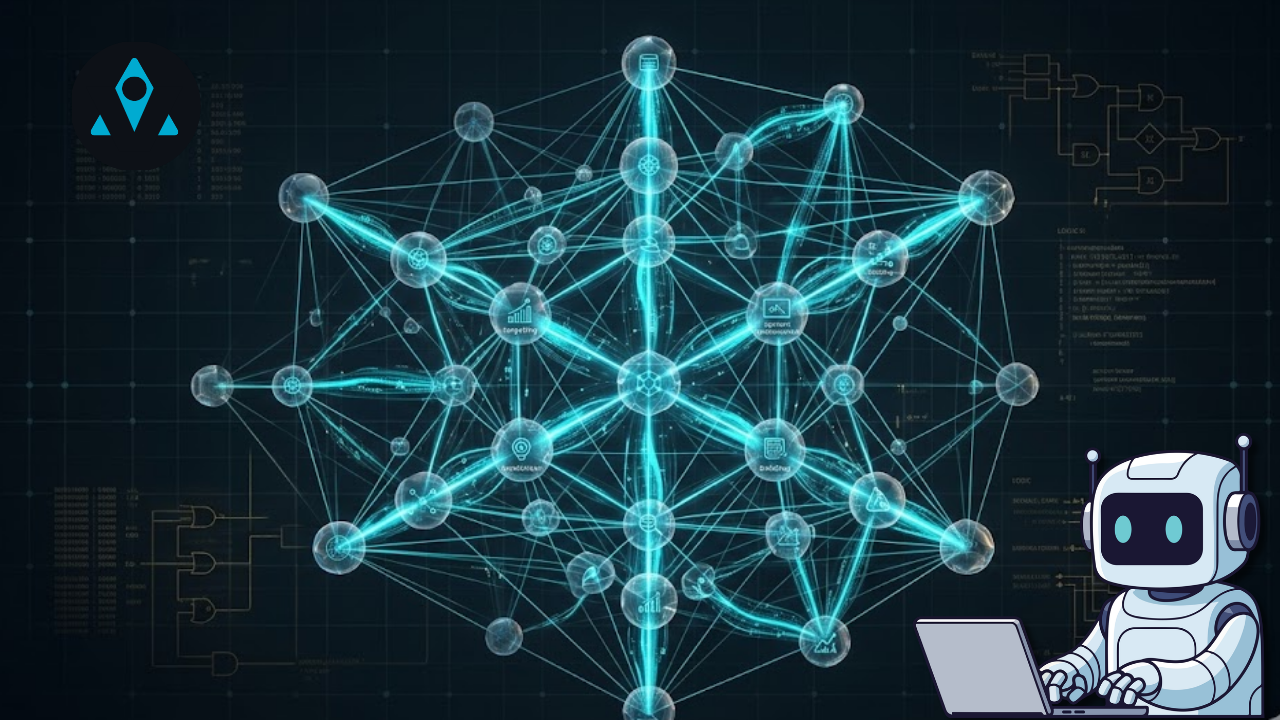
Thanks to The Orchestration Layer, AI is no longer the same tool we used to prompt-and-respond to. An agentic marketing platform is built up of several agents, including, but not limited to, lead scoring, creative, and multi-channel distribution.
Agentic AI versus Conventional AI
Conventional AI normally does data analysis and makes predictions, but does not act. Agentic AI can act, but more importantly, can reason, plan, and act on sub-goals with little to no human oversight. For Agentic AI, goals can be divided into more manageable sub-goals, which it can then complete by utilitarian reasoning, data, and tools.
The agency-brand relationship will have to adjust in the context of their new reality. The question agencies will have to increasingly answer is whether they are addressing a human in their marketing efforts or an Agent representing that human.
Influence on Operations
- Velocity: Time-consuming campaign launches that required weeks of planning are now completed in days.
- Capacity: Multi-channel strategies and audience expansion are now tenable on a day-to-day basis, rather than occupying the entire team.
- Constant Improvement: The feedback loops built into these systems of higher intelligence govern context-relevant resource allocation.
III. From Commodity Impressions to Contextual Effects
For decades, the industry dealt in “impressions” — a metric that frequently undervalued the media context. Now, the context is positioning itself as the primary competitive differentiator.
Going Past the 100 Millisecond Auction
Classic programmatic systems must reduce all inputs to a single “bid price” within a 100-millisecond window. This led to the neglect of numerous high-quality, specialized inventories. Agentic Advertising substituted this for Outcome-Based Negotiation. With the Ad Context Protocol (AdCP) and other similar protocols, AI agents are able to negotiate on the matters that are actually important: brand lift, conversion, reach, and even sustainability.
Limitless Discovery
These changes bring the promise of “limitless discovery,” showcasing novel inventory that was previously obscured by auction models. With agent-to-agent interaction, the publisher is now able to communicate their value to the brand’s agent. For instance, high-quality niche content that was devalued in a bundled programmatic auction can now be valued on its true worth. In addition, the old data arbitrage model is turned on its head; with agent advertising, the media owner retains the value of their data.
IV. Composability: The Starting Point of The State of The Art Stack
By 2026, inflexible, “monolithic” technology stacks will become deprecated. New and emerging privacy and identity regulatory changes will make such stacks infeasible. The answer is composability, which is the ability to construct your stack using multiple modular, interoperable components.
Flexibility as a Must
A “composable architecture” allows brands to modularly compose services around a strategically identified core. The transition from “Frankenstacks” to modular design is a necessity to thrive in complex environments.
- For Publishers: Composability allows identity services, clean rooms, and measurement tools to be modular.
- For Agencies: Composability leads to modular, API-first models that allow agencies to shift and mix their tools.
V. Strategy Returns to the Center
At one point, we worried that AI would make all creative work the same. Today, in 2026, we can see that AI has actually returned Strategy and Creativity to the center.
Removal of the Execution Bottleneck
Now, when AI agents take care of media planning, trafficking, and reporting, the execution bottleneck has disappeared. Humans have moved upstream. Now, marketing teams spend time making decisions instead of spending 80% of their time on execution.
- Narrative Creation: What story/s do we want to tell, and what are the ways that we express the brand?
- Definitions of Success: What is truly considered to be the winning outcome (e.g., brand health, customer lifetime value, sustainability)?
- Evaluation of Performance: Determine how much freedom to give the systems that accomplish these outcomes.
VI. Self-governance of Autonomous Systems
Governance and control of autonomous systems seem counterintuitive. However, both are necessary to responsibly harness the benefits of AI for the first time.
Dual-Axis Governance
Agent platforms of the Enterprise Class now include critical governance layers:
Automated Safety
- Automating the URI filter
- Auto-blocking and audit logs of damaging inputs
- Labeled and internalized prompts
Human Oversight
- Access control, editing, and legal review clearance
Centralized Brand Intelligence
Labels, tunnels, archetypes, or Arc Graphs comprise Brand Intelligence systems. To create a brain for the AI system, brands educate the Arc Graph on their voice, representations, and target communities. With this, the agents can ensure creative outputs are consistent and recognizable despite their variations.
VII. Conclusion: What’s Ahead for 2026
The advertising ecosystem is rapidly evolving. 2026 is the first year when the infrastructure on which we are building other IoT applications will be more robust. Marketing leaders will need to focus on:
- Total Autonomy With Control: Creating the ability to zero preference at the ultimate level of control.
- Composing Infrastructure: Being able to alter the tech composition dynamically.
- Partnership Recontextualization: Integrating networks of clean rooms and digital retail spaces.
Key Takeaways for the Agentic Revolution:
- Agent > Consultant: Agentic AI receives a target and completes the entire workflow.
- AdCP: New advertisement language where agents negotiate for priorities.
- Composable: Lego-Tech allows replacing modular pieces instead of altering entire systems.
- Human = Governor: Setting boundaries and defining “success” in a Knowledge Graph.